
Ten Footsteps 2026, course 31
Welcome to the course
Welcome to the Ten Footsteps training programme from Live Well with Pain.
This training will focus on helping you to gain more knowledge and skills to support people with persistent pain. It covers ways to support self management of this long-term health condition with more confidence, using a wider range of resources, tools and skills.
We hope you’ll find the sessions interesting and fun. The course is a co-production of practitioners together with people who live with persistent pain, co-delivering.
Each session will be delivered by a team consisting of two facilitators with lived experience (we call them Lived Experience Trainers or LETs) alongside two facilitators who are health care practitioners with a special interest in pain.
Pre-course preparation
1. Familiarise yourself with Live Well with Pain
As part of your pre-course preparation please ensure you have explored our website.
The practitioners’ guide to the Ten Footsteps is a good place to start, as it takes you through the ten footsteps around which your training will be structured.
Next, explore the approach used by Live Well with Pain, which is based on the Five Areas CBT person centred model.
This website also has a wide range of self-management resources. Have a look at the downloads that you can share with the people you are supporting, and visit the skills and knowledge section to see the kinds of techniques that you’ll be able to explore in more depth during the training course.
2. Watch this short video animation ‘Tame The Beast’
How might you use this in practice?
3. Access the Health and Wellbeing Tool
Complete it online or as a printed copy of the PDF for a) yourself or b) with a person who lives with pain. The result will guide you or the person you are working with to different resources on the LWWP website.
This is an invaluable tool as Step 3 and 4 shares what the person sees their priorities at the current time.
It also informs you and the person you are working with of level of the severity of the impact of the pain on their health and wellbeing. The severity of the level impact is mild, moderate or severe. It helps to know if the person has severe health impact of pain, as it means this person is likely to need extra specialist input.
Based on WHO criteria, this tool is also useful for data collection and outcome measurement, pre- and post-intervention, or in service evaluation e.g. Pain Cafés or Pain Management Programmes.
4. Find and download the ‘Pain Cycle / Self-Care Cycle’
Have you used this, can you try it out before the first session?
5. A visual tool that that can be used instead of the Pain Cycle, is ‘Pain is like an iceberg’
Can you find it on the website, and try it out before or after the session?
We will revisit these resources and tools in the first session. We will see which have been used, what was helpful, and what challenges you faced using them.
Doing this ahead of Session One will allow you to get the most out of 10 Footsteps Training and will be covered again in the session. Any concerns or problems please get in touch with Claire Packwood on: lwwp.training@gmail.com
Pre-course evaluation
Before beginning the training, we ask all participants to complete a brief online self-assessment of your knowledge and skills.
This will help you be clear about your learning needs and plans for the Ten Footsteps training. It will also help us ensure the training is focused on participants’ needs.
You may also find it useful to make a note of your two stronger skills and two of your weaker skills areas to guide your goals for learning!
Pre-course evaluation
Session dates and links
Session 1: Thursday 17 September 2026, 09.30 - 13.00
Join Zoom Meeting
Session 2: Thursday 24 September 2026, 09.30 - 13.00
Join Zoom Meeting
Session 3: Thursday 1 October 2026, 09.30 - 13.00
Join Zoom Meeting
Recordings and resources
Session 1
Session 2
Session 3
Please explore these useful tools and do try one with people with pain between training sessions to feedback into the next training.
Session 1 resources
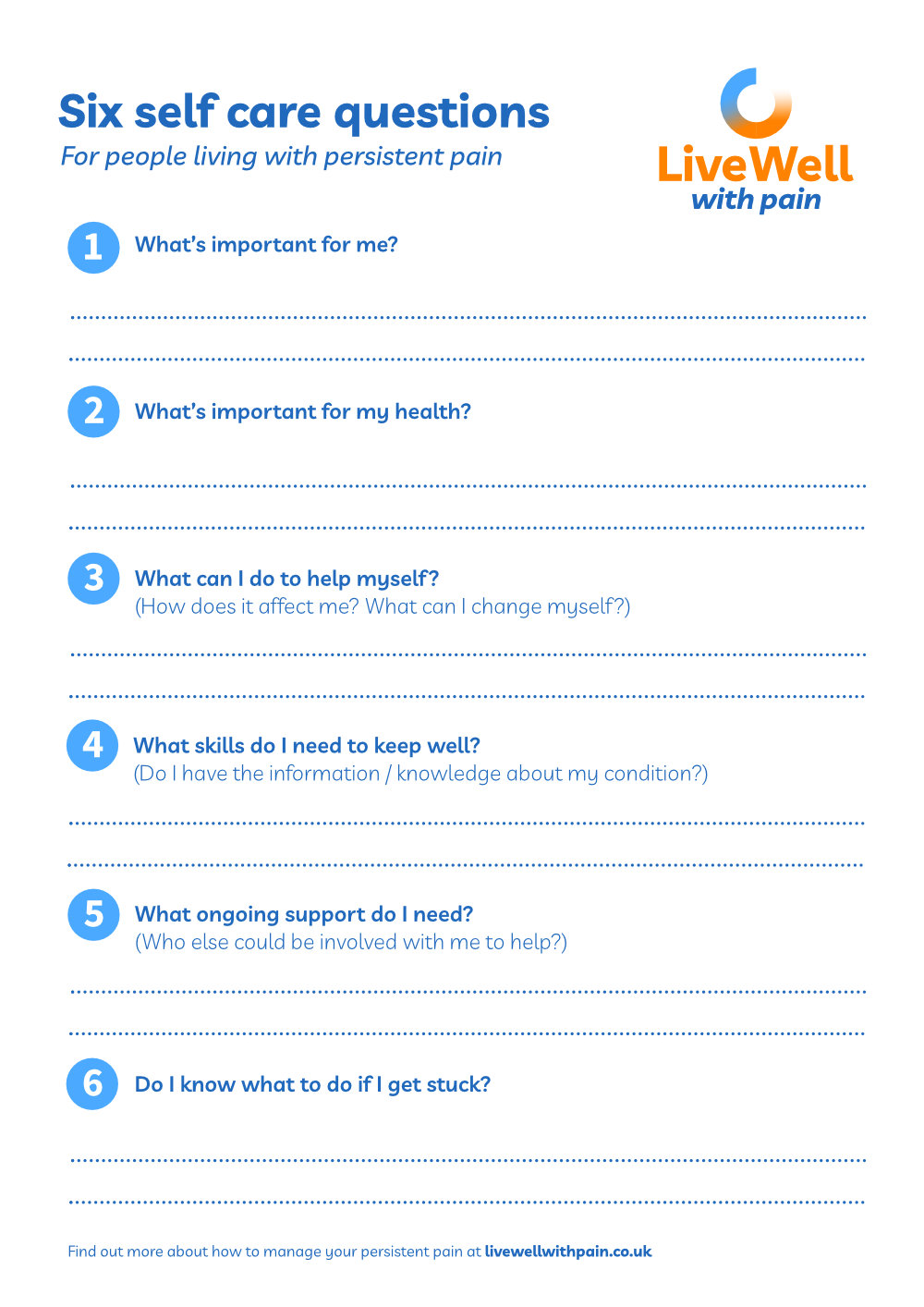
Six Self Care Questions
A great way to get people thinking about self care in a constructive way, the Six Self Care Questions can be used at any stage in your work with them around managing their pain.
The person can complete with or without help and then to share with you. This helps them shape values and goals for their self-care journey.
Pain management and action plans
Explore this video to add additional skills that are shared in use of pain and self-care cycle
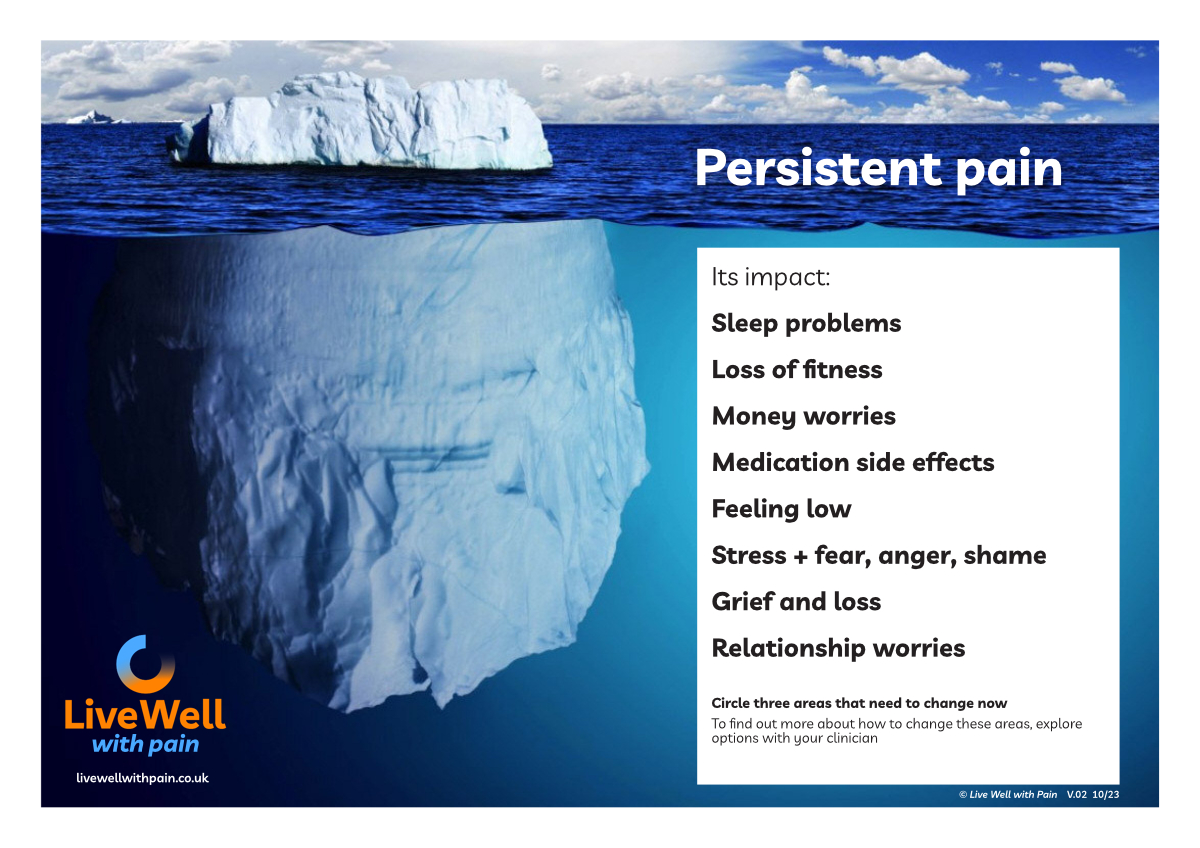
Pain is like an iceberg
Persistent pain is like an iceberg – there’s so much more to it beneath the surface. Use this sheet with your patient to explore how pain impacts many different areas of their life – areas that could be addressed using self management strategies.
Or try putting it up as a poster in a waiting room or as a handout before group sessions.
Physician Empathy and Chronic Pain Outcomes
Thought provoking article in JAMA about the importance of trust, relationship building and empathy. What do you think about this article?
A bus journey
The Bus Journey tool is a metaphor tool that can help people understand pain is part of them and their life at present. This is about learning ways to self manage pain by:
- Letting the person decide where they want to put the pain on their bus now, rather than in the driving seat or at the steering wheel.
- Supporting the person to decide what is the new direction of the bus journey, its route, new stops and which passengers they want on the bus from their family, friends and clinical team, social prescribers etc.
- Helping them set rewarding, paced goals and focus on their priorities for change.

Top priorities for people with pain
Check this data analysis of the Health and Wellbeing Tool responses from over 2,000 people. It shows what the top four priorities of key health needs for people with pain.
Session 2 resources
Footstep 6: Sleep
Sleep is really important. In fact it’s often cited by people with pain as their number one health need to change!
See the link from Session 1, above, to the most recent data from our Health and Wellbeing Tool.
Explore our practitioners’ guide to using Footstep 6 – Sleep here.
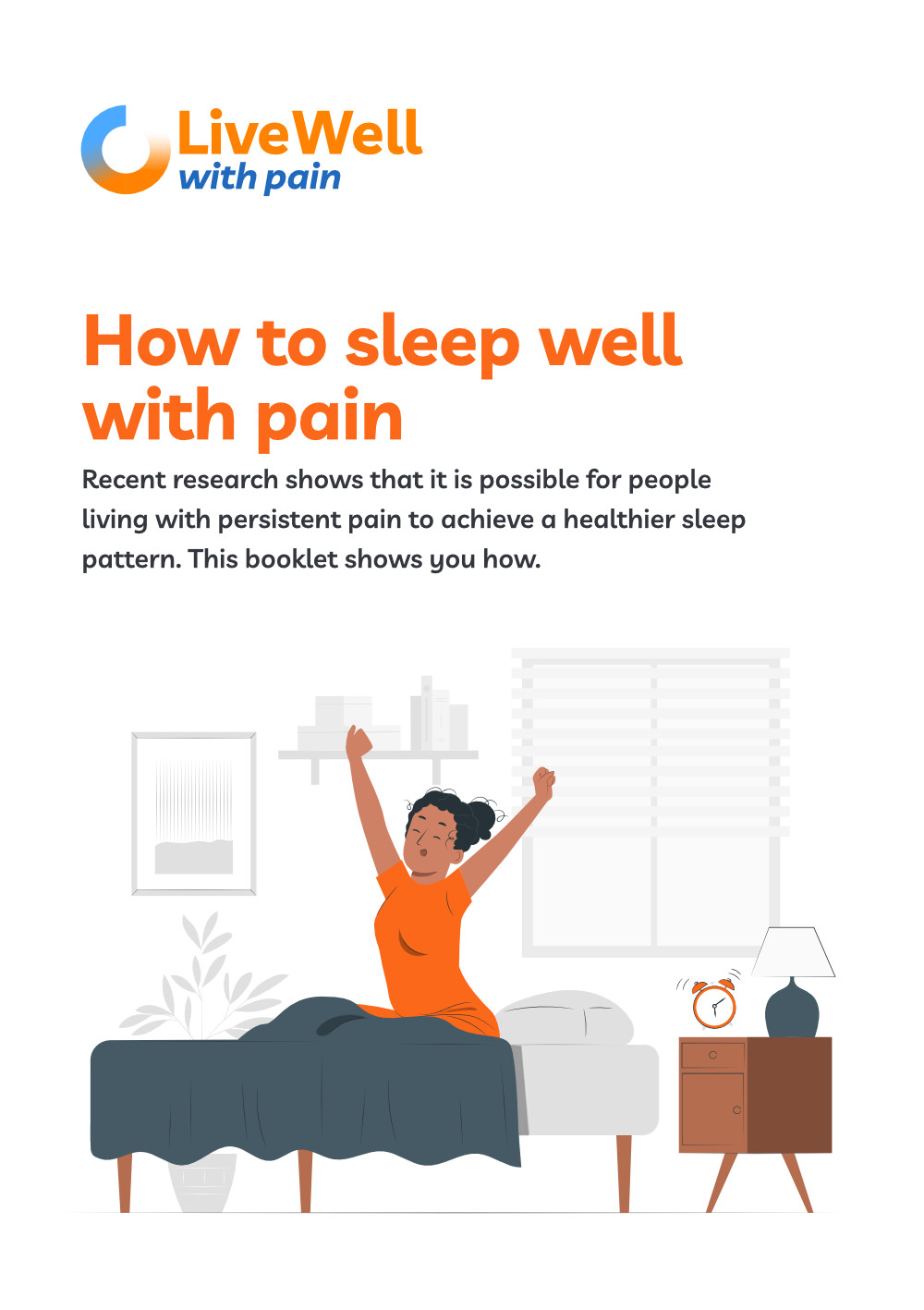
How to Sleep Well with Pain
ALSO AVAILABLE AS A PRINTED BOOKLET
This leaflet draws on recent sleep research and provides simple-to-follow guidance for patients to develop the skills they need to start getting a good night’s sleep.
Obstructive Sleep Apnoea
Obstructive Sleep Apnoea (OSA), a very common sleep problem. Learn more about it here.
Quick OSA Quiz:
-
What is the sound that people make with sleep apnoea?
-
What is STOP BANG? Maybe use it yourself or with someone you know may have sleep apnoea.
-
What one thing did you discover in the video on sleep apnoea and fibromyalgia? (in HCPs resources)
-
How can you help people explore this possible condition and seek help from GP?
Circadian rhythms
Learn more about the historical context to circadian rhythms here: ‘Little Sleep / Big Sleep’ or biphasic sleep patterns.
Footsteps 3 and 4: pacing and setting goals
Explore our practitioners’ guide to Pacing and Setting goals.
Perhaps try the Goal Ladder or share the pacing leaflet (you can download them below) or share the video we watched with the individual/s you are working with.
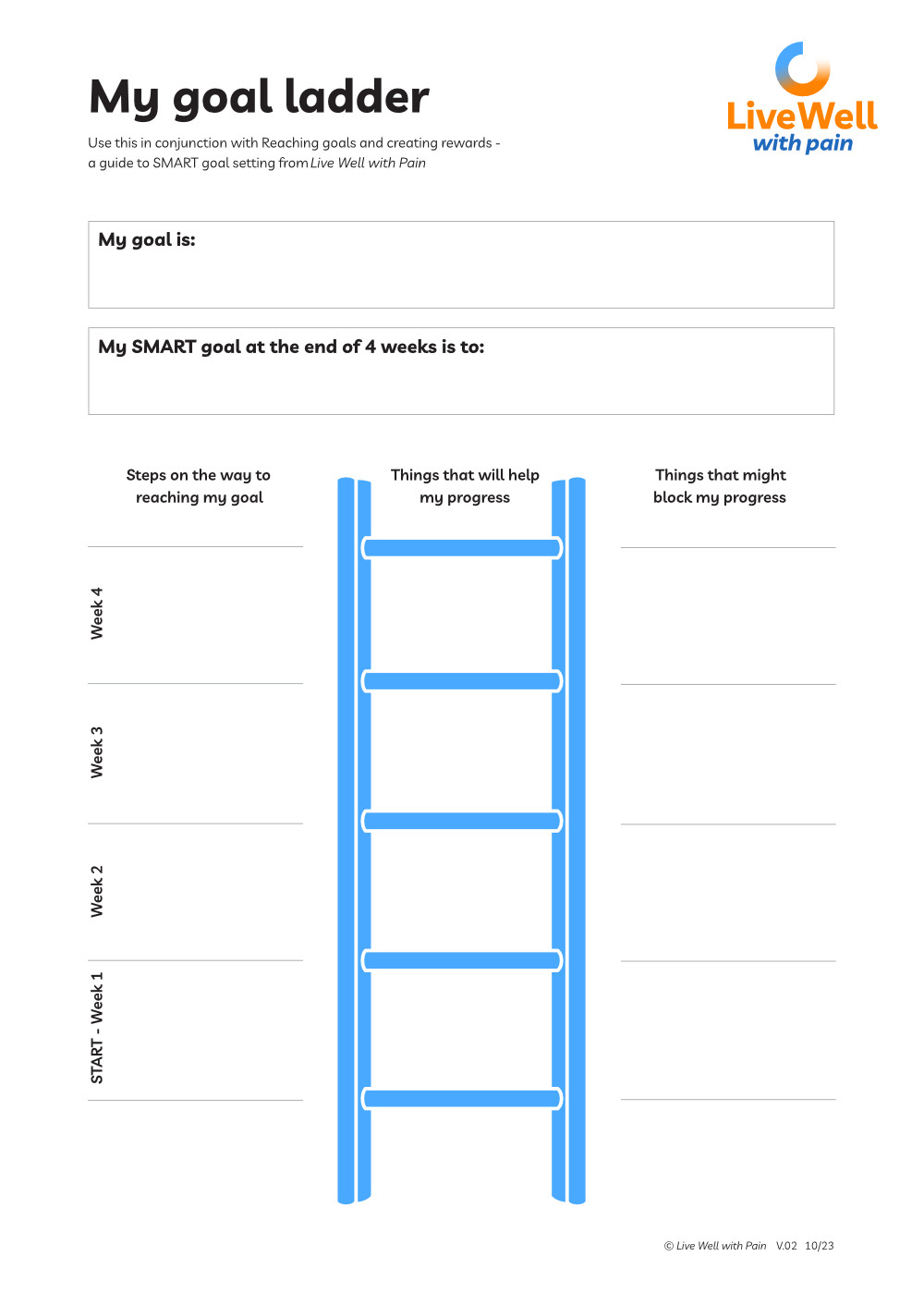
My Goal Ladder
Many people find it useful to think about their SMART goals like steps on a ladder. This A4 sheet will help a person to break down each goal into small, achievable steps. These can be used to build up, week by week, towards a bigger goal.
It should be used in conjunction with the Goal setting booklet.
Pacing
ALSO AVAILABLE AS A PRINTED BOOKLET
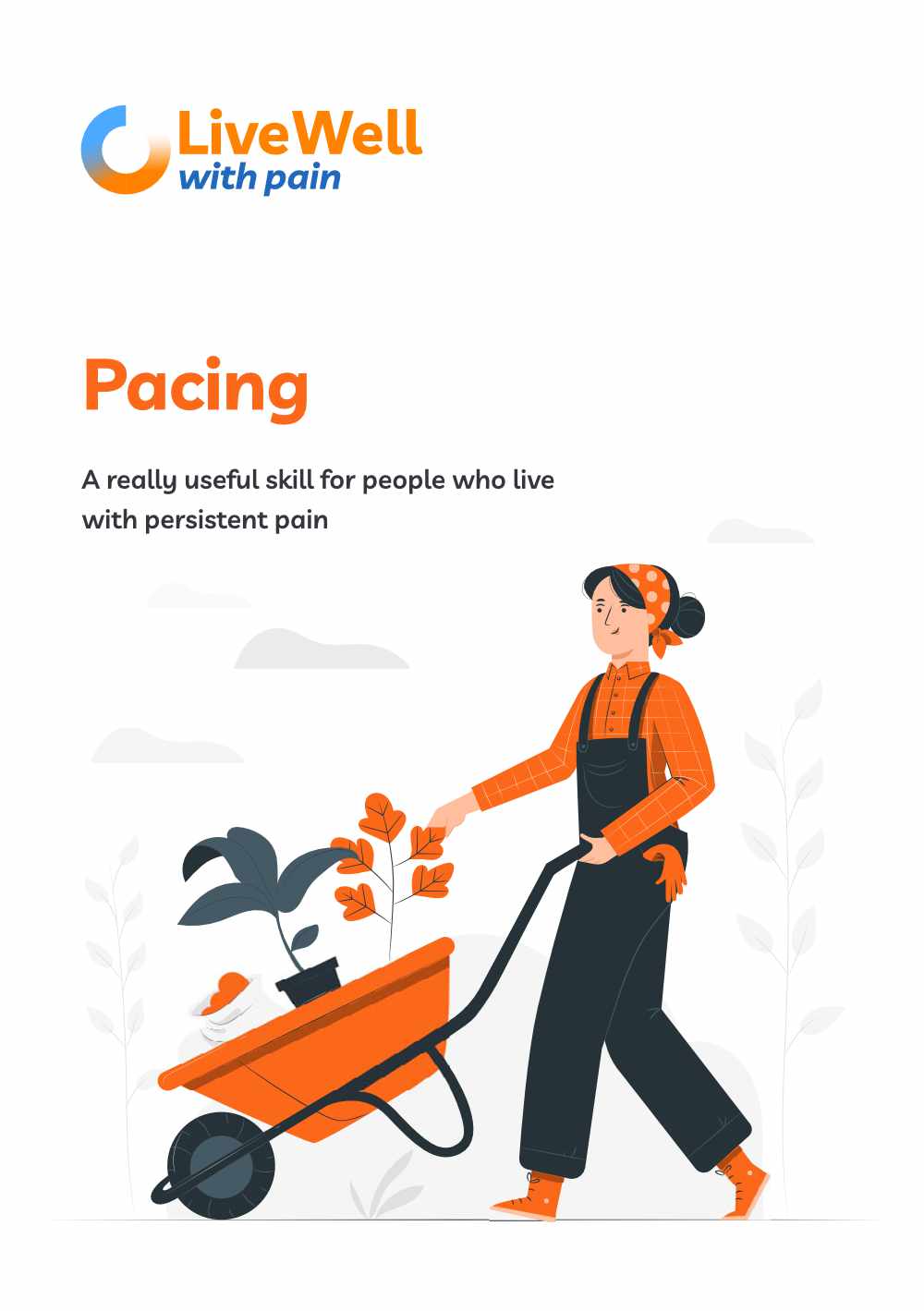
Pacing is a key everyday skill to learn and use for people living with persistent pain. This leaflet offers useful techniques for learning how to balance activities through the day and avoid the common 'boom and bust' cycle experienced by many with persistent pain.
Session 3 resources
i) Communication
Explore this video about metaphors: Using metaphors to explain pain
Try out a metaphor you feel comfortable with a person living with persistent pain.
ii) Managing medicines safely
Explore this NHS South West web page and video to help improve your confidence to help people use medicines safely and/or seek professional help initially from GP or Community Pharmacist.
Read and find out more on these tools:
Ask yourself six questions
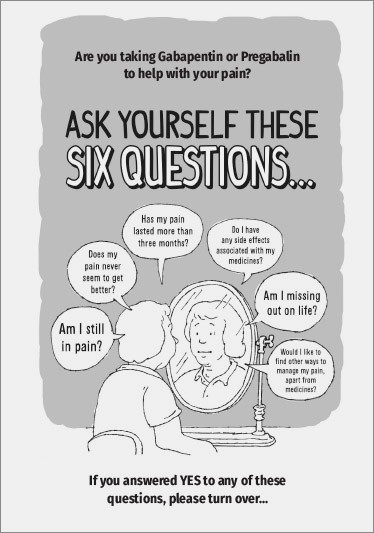
Designed for patients who have been taking Gabapentin or Pregabalin to help their long term pain for more than three months, this leaflet invites them to consider six key questions. And if their answer to any of them is ‘yes’ the leaflet provides an accessible overview of the main issues and what else, apart from opioids, a person can do to manage their persistent pain.
Ask yourself six questions
Designed for patients who have been taking Gabapentin or Pregabalin to help their long term pain for more than three months, this leaflet invites them to consider six key questions. And if their answer to any of them is ‘yes’ the leaflet provides an accessible overview of the main issues and what else, apart from opioids, a person can do to manage their persistent pain.
An opioid thermometer
How much opioid is a person taking? The opioid thermometer helps to estimate dosing based on oral morphine equivalent dose, and can be used to guide safer prescribing.
The PDF contains two versions: the first goes up to 120mg morphine per day, the second to 250mg morphine per day.
The Great Opioid Side Effect Lottery
Often, patients being prescribed opioids for their persistent pain do not know how little benefit they offer over the long term, or how prevalent and varied are the side effects people experience.
This A4 sheet, designed to be used by clinicians in their consultations with patients, is a simple way to raise the question of benefits versus side effects.
Using a ‘lottery scratch card’ metaphor, the sheet explains that opioids only actually reduce pain for around 10% of people in the long term, and their side effects can be both wide ranging and serious.
It lists many of the side effects, and provides a number of statistics to show how common these side effects are.
Working through the list with your patient, ask them to tick those side effects they are experiencing, as a starting point for introducing the idea of a medicines review.
. . . and help one person complete it and make a goal using either REST or SMART.
Opioids Aware website is very helpful for starting conversations about pain and medication as well as latest advice: explore it here.
iii) Medicines reviews
Wath this video outlining shared decision making, assessment of confidence and existing self-management skills. How can these skills be adapted even if you are not a prescribing clinician?
Medicines Review video
iv) Nutrition and chronic pain
The Chronic Pain Cookbook from Live Well with Pain is FREE to download and try.
Thank you for all your contributions to the sessions! We hope this is the start of a journey increasing your confidence and skills in supporting people to live well with chronic pain. Keep exploring and trying out the Live Well with Pain resources here in the Training Zone and on the wider website and let us know of your successes or any queries or training needs going forward.
Session slides
Download PDF of session 1 slides
Download PDF of session 2 slides
Download PDF of session 3 slides
Written reflection
As part of your learning we encourage reflection on your practise. To help with this we have created a form which you can complete online, here:
Complete your reflection
Please complete the form with:
-
a reflection about an encounter when it was difficult to support somebody with self management
-
a reflection about an encounter when you used your skills in supporting self-management successfully
If you would like to keep a copy of your responses please save the PDF that you see when you submit.
Accreditation
Once you have completed your course, you will be able to obtain a Certificate of Attendance from the Personalised Care Institute (PCI). This is worth 12 CPD points.
After the third and final session, we will email you a link to create an account with the PCI, so that you can obtain your certificate.
Post-course evaluation
As part of our continued accreditation with the Personalised Care Institute, all course participants are asked to complete a post-course evaluation.
You can complete this online, here:
Post-course evaluation